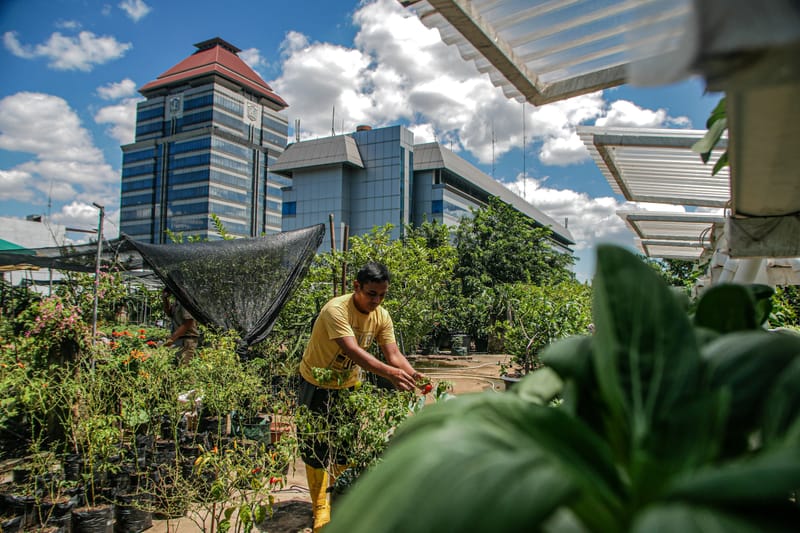
How City Farms Can Help to Feed the World
7
Advanced
Vocabulary
Repeat each word, definition, and example sentence after your tutor.
urbanAdjectiveˈərbən
in or relating to towns or cities
I grew up in the countryside, so it took me a while to get used to urban life.
greenhouseNounˈgriːnˌhaʊs
a glass building used for growing plants
The first thing I do every morning is water the plants in the greenhouse.
pesticideNounˈpɛstəˌsaɪd
a substance used to kill insects or animals that damage crops
Wash your greens thoroughly in cool water to remove any pesticide residue before serving.
absorbVerbəbˈsɔːrb
to take in a substance, such as a liquid, gas, etc.
Indoor plants help purify the air by absorbing pollutants and releasing fresh oxygen.
carbon footprintNounˌkɑːrbən ˈfʊtprɪnt
the amount of carbon dioxide produced by the activities of a person, organization, etc.
Switching to a plant-based diet is one of the easiest ways to reduce your carbon footprint.
renewableAdjectiveriˈnuəbəl
(of a natural resource or energy source) able to be replaced
Nearly 85% of Iceland's electricity comes from renewable sources.
Article
Read the article aloud on your own or repeat each paragraph after your tutor.How City Farms Can Help to Feed the WorldWhen you think about where your food comes from, you probably imagine fields in the countryside with animals and tractors. But more and more of our food is actually being produced in towns and cities.
According to a report released earlier this year, urban farming is a rapidly growing global business that is already worth over $5 billion.
The report from the Food and Agriculture Organization of the United Nations found that this growth has been made possible by high-tech farming systems, such as indoor vertical farms with LED lights and remote-controlled robots.
In some ways, urban farms can be better for the environment. Because of their controlled environments, farms inside greenhouses or buildings use less water and land, and require fewer or even zero pesticides.
Because city buildings and roads absorb and hold heat, cities often experience a heat island effect with much higher temperatures than surrounding areas. But urban farms can help reduce this effect.
For example, when food is grown on rooftops, the plants can help keep the buildings cool, which also helps cut energy costs by reducing the need for air conditioning.
Another big benefit is that food grown in the city can be eaten right there, it doesn't need to be sent long distances, and this reduces its carbon footprint.
One problem of farms inside greenhouses or buildings is that they require a lot of energy to run. So it's better for the planet, and probably more affordable for urban farmers, if they use renewable energy like solar or wind power.
A study done in 2018 found that urban farms were already producing between 5% and 10% of the world's vegetables. And an Australian study published in August found that urban farming can improve global food security.
When we consider how to feed the world's growing population, it seems that urban farming has an important role to play.
Discussion
Have a discussion based on the following questions.- What are your thoughts on the rise of urban farming?
- Do you think urban farming will continue to become more common?
- Are there many green spaces in your neighborhood?
- Do you grow any fruits or vegetables at home? Would you like to?
- If you had a big garden, what would you grow or plant?
Further Discussion
Have a discussion based on the following questions.- Do you have any indoor plants? Are they difficult to care for?
- Do you know any keen gardeners?
- Do you think you'd enjoy living in the countryside?
- What are some of the most beautiful rural areas in your country?
- To plant a garden is to believe in tomorrow. — Audrey Hepburn. What do you make of this quote?